
History
Oignies and Thièrache
Oignies was once known as the village of widows; at least 80% of the women there were widows. Oignies was a poor settlement where people mainly worked in the slate quarries. The working conditions were so poor that many men lost their lives. You can also visit a quarry yourself, for example in Hamérienne or Trou des Pauvres.
Domaine des Nobertins
It should actually be "Domaine des Norbertins," "Norbertian domain." Research shows that the "r" has been lost somewhere among the locals. A short "o" followed by the letter r or s becomes a long "o" (represented by "ô"), for example: borgne becomes bôgne in the South Walloon dialect.
The domain once belonged to the Norbetines.
The Premonstratensians, or Norbertines, are a monastic order of regular canons of the Order of Prémontré. This monastic order was founded in 1121 by Saint Norbert of Xanten in Prémontré, a municipality about twenty kilometers from Laon in northern France.
The Norbertines are also called whiters after their white habit and white cowl. The Norbertines live according to the Rule of Augustine. Their motto is ad omne opus bonum paratus ("ready for every good work"). They not only live contemplatively but also focus more on practical preaching and pastoral care. This monastic order soon flourished.
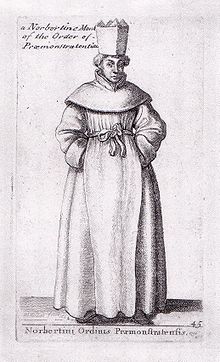
The rest of their history is one of ups and downs. Abbeys were regularly abandoned and they had to move to safer places.
The French Revolution brought it to the brink of ruin: convents were often closed, their inhabitants expelled, and the buildings sold at public auction. However, it recovered during the 19th century.
Source: nl.wikipedia.org
In 1932, the estate belonged to Madame Julia Mineur, widow of Monsieur Baron Mourice Lemonnier (12/01/1860 – 11/09/1930), a native of Brussels. Maurice Lemonnier was the son of postal collector Hubert Lemonnier, president of the Civil Hospices in Anderlecht, and Julie Alexandre. He married Julia Mineur (1872-1945) in 1894. The couple remained childless. Lemonnier was a lawyer and a civil mining engineer. He became a Brussels municipal councilor in 1890 and an alderman in 1905. He was acting mayor of Brussels from September 26, 1914. He was also a Liberal Member of Parliament from 1892 to 1894 and from 1902 until his death. He became Vice-President of the Chamber of Representatives. In 1922, he was granted the hereditary nobility the title of baron. He was, among other things, a Grand Officer of the Order of Leopold, a Grand Cross of the Order of the Crown, a Grand Cross of the Order of the British Empire, and a Grand Officer of the Légion d’Honneur. 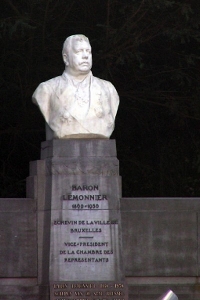
On the corner of Avenue de Cérès (Brussels) stands a white marble bust, a sculpture by Frans Huygelen modeled on Thomas Vinçotte, inaugurated in 1932. http://www.irismonument.be
Upon the death of his wife, Julia Minieur, on January 15, 1945, the Estate was divided among the heirs of René Simon, Maurice Simon, Léon Lenoir, and Robert Lenoir.
In 1964, the Estate was sold for 12 million Belgian francs (approximately €300,000) to Mr. Van Steenberghe, Mrs. Van Steenberghe-Kahn, and Joseph Xavier Hubaux. During this period, the division into plots began, and the first buyers arrived.
Mr. Joseph Hubaux died on September 26, 1972, leaving his two children, Mr. Jacques Joseph Xavier Hubaux and Marcel Joseph Hubaux, as his sole heirs.
In order to regularize the existing situation and obtain permission for the construction of permanent structures, initially considered illegal, the A.S.B.L. "Les Amis du Bois des Nobertins" (NPO "The Friends of the Nobertine Forest") was established on October 7, 1973.
To obtain a municipal operating permit, the articles of association and internal regulations of this NPO (which together form the founding act) were submitted for approval to the municipal administration and the urban planning and spatial planning administration of Oignies-en-Thiérache. On October 25, 1973, the Board of Mayor and Aldermen endorsed this founding act as a basic condition for the continued operation of the Estate.
The Provincial Executive of Namur, in turn, granted permission for further exploitation of the estate on November 28, 1973, also expressly conditioned on compliance with the statutes and regulations as established at that time and published in the annexes to the Belgian Official Gazette on March 7, 1974. These provisions, amended where necessary to reflect changes in legislation, remain fully applicable.
The exploitation permit includes provisions for the development of the plots and of the Estate as a whole, including the development, management, and maintenance of the de facto co-ownership (roads, water extraction and distribution, high-voltage power reception and low-voltage distribution) and the supervision of compliance with the internal regulations. The de facto co-ownership is recognized by the judicial authorities. These internal regulations assure the licensing authorities that the exploitation is carried out in accordance with the optimal preservation of the Estate's forest heritage.